

Evolutionary fear and survival talents are hardwired into us as humans. Harry de Bont explains how to turn our instinctive defence mechanisms from fear-based behaviours into a source of courage, power and creativity.
Evolutionary fear and survival talents are hardwired into us as humans.
Our highly attuned sense for danger and the ways our body responds to it have been so successful that they’ve helped our species evolve to dominate this World (in many cases, with highly negative consequences).
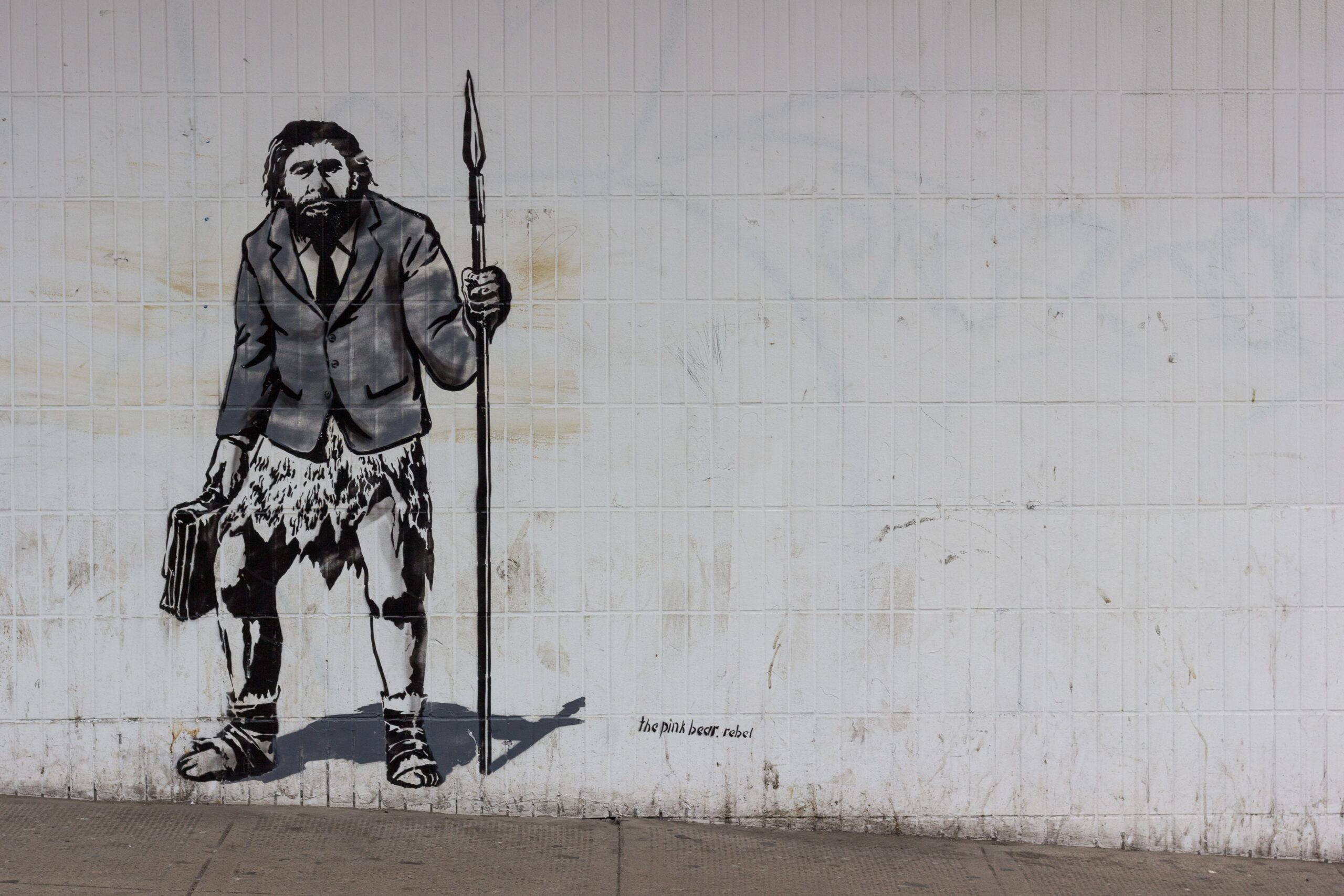
The survival skills that were so deftly optimised for our ancestors’ lives as hunter-gatherers aren’t as relevant in today’s modern society. Yet our physiological responses continue to operate just as they always did.
That’s something we will never be able to change. However, we can learn to develop greater awareness of our instinctive reactions and take steps to workaround them.
That was the theme of my podcast conversation with Harry de Bont, a coach and strategy adviser based in The Netherlands.
“Evolutionary fear refers to the vigilance we all have in trying to seek the dangers out there and respond to them. This comes with a heightened state of alertness, stimulation of hormones and different energy housekeeping,” begins de Bont.
“If you look at our evolutionary track record, there’s good proof of that, because we made it this far. We were hunter gatherers for around 270,000 years and that is ingrained in our DNA. Evolutionary fear in itself is very effective if there is real life danger.
“As we were both hunters and also prey, we have the ability to be in two states. Either we were being hunted, or we were dealing with less threat as a predator, seeking our food, socialising and being creative as tool makers and care takers. Those are two different states of being, one way more relaxed than the other. And that’s what you find in modern society too.
“But as we don’t have actual real danger – like bears or wolves – to contend with anymore, our modern selves get into a third confused state of perceived threats and false beliefs.
“We start to act erratic and show ineffective behaviour.”
‘The five survival talents’
De Bont refers to the behaviours we exhibit when in a state of fear as ‘survival talents’. So called because they have indeed been very effective at helping us survive.
“I call these ‘survival talents’ because they really shine when there is a real life, threatening situation at hand:
- Fall in line
We fall in line with the group and operate as a collective. - Laser focus on threats and danger
We experience a heightened state of awareness. - Suppression of individual needs
Without questioning, we sacrifice our individual needs to the greater needs of the group.
- Heightened fight performance
We experience extra human strength, for aggression or defence. - Flight to save our life
If all else fails we still have the ability to flee, or freeze up to hide from the danger.
The downside of survival talents
Whilst very effective, these survival talents put stress and exertion on our bodies.
Indeed, our ancestors would have used these skills sparingly. Genuine attacks from predators would have been relatively rare, and they would only have hunted for an estimated 16 hours per week. The rest of the time, evidence suggests, they lived a life of leisure and relaxation.
This is in stark contrast to our modern society. Dangers these days are even less likely to come from predators looking for lunch. Instead they have been replaced with many different ‘threats’ or stressors such as those created by work demands, financial insecurities and social anxieties.
Yet our primitive brains and body systems don’t draw a distinction. Nor have they evolved to replace our outdated survival talents.
The result is that many of us live in an almost permanent state of survival instinct. And over time, this takes its toll.
“When you’re facing a predator it’s really clear where the danger is. And when it’s dead, it’s also really clear when there is no longer a danger,” explains de Bont.
“That’s the big difference with today’s society. If we have a perceived threat, which is often misconceived, nobody or nothing is going to tell us when that danger is over, so we just stay in that state, and that really drains our bodies.
“The hormonal support system that we have for our defence mechanisms and aggressive behaviours isn’t built for a long duration. After half an hour it’s done and because it gets its energy from the digestive system and immune system, it’s really harmful for the body as well.”
Not only do our confused bodies wear themselves out being in this permanent state of alertness, these instincts can often lead us to adopt courses of action that might not be the most helpful for us.
For example the ‘fall in line’ talent where we act as a group can result in us becoming a sort of a slave to the system.
“An example of this would be in a company where there are high levels of stress, and you see people working 60-plus hours per week because there’s still an action list for the project and they feel they can’t stop.
“They keep on going, putting the needs of the collective over their own because they feel they must. And in the end that’s very unhealthy and ineffective.”
Recognise your state
So all of this begs the question of what can we do if we suspect that we’re spending a lot of time in survival mode, experiencing high stress?
“The important thing to know is that there are three states of being:
- Defending yourself because there is a genuine danger.
- Relaxation when you’re in a growth state and you’re being creative.
- Where you are acting or reacting on a misperceived reality.
That’s the one that creates that restless, stressed-out feeling.
“The key is learning to recognise in ourselves the difference between these three states. Then you can start to shift from this evolutionary fear to a more courageous and creative lifestyle.
“Now, that’s not something where you can just flip a switch, read a book and you’re done. It’s something you really have to practice. But it begins with recognising that difference.
“I see a lot of people in that third state these days. They make an appointment with me because they’re really stressed out at work, and it’s very typical that these people come late for the appointment because they had so much to do, they couldn’t let go of their work. That’s a typical pattern.”
How to get out of ‘survival mode’?
De Bont’s conclusion after studying this subject for a decade is that it doesn’t really matter what people do to calm down, as long as it’s something that they wouldn’t do when they are in actual danger, and that can be different for everybody.
“It could be a walk in the park, it could be gardening, it could be taking a hot bath – it could be anything actually as long as your body thinks, “I wouldn’t be doing this if there was danger.” And that means you recognised the ineffective state, you pressed the pause button and switched to something else.
“Then, when you’ve paused and are more relaxed, it’s time to take care of yourself, start doing what you need and growing towards your talents. Because that’s really the other side – where you take yourself seriously and be faithful to yourself.”
The critical three-step process:
- Recognise
- Pattern break
- Apply a courageous behaviour towards developing your talent
And this is where the real magic of de Bont’s approach comes in. Identifying when we’re in an ineffective, stressed state is one step, then hitting the pause button, but it’s what we do from there that turns a negative into a positive and better safeguards us from being so quick to fall again into the trap.
“A lot of the interventions you see from people working with burnout and stress are good to the point where they help people relax for a while. But when the relaxing activity is over – meditation, a walk in nature etc – often those fear patterns return and then people are back where they were a day later – maybe an hour later!
“So I believe that what we all have to do is get into that second state of growth and relaxation where we engage our talents and find meaning.
“We’ll never be able to stop our survival talents because they are hardwired within us. But we can meet them with an equal partner on the creative side.”
Creative growth orientated talents
de Bont’s model matches the five survival talents with five creative, growth orientated counterparts that we all have in common.
- Play with possibilities
What are the options for us?
e.g. Maybe we live near the sea, or in a city with great facilities. Maybe a tight-knit, supportive community. With the Internet at our fingertips, we all have more possibilities than at any point in human history. - Performance
What are we capable of? This is where we test and grow our capabilities. - Values
What is important to us? This is how we begin to differentiate ourselves from the group. - Motives
What energises us? As we get to know ourselves better we learn where focusing our energy gives us energy in return. - Meaning
What do we live for? This is where we experience fulfilment from putting something out into the world that is seen by other people.
“The key message is to choose to be playful when we’re in a place of fear, and to challenge ourselves when we have the fear of failure.
“And when you have a feeling that you must sacrifice for the group, instead choose something that’s totally for yourself. Focus on what you’re creating in this world, rather than on something or somebody else that might be a threat to you.
“Find meaning in what you do instead of falling in line and just doing what your to-do list tells you to do.
“It’s never too late to start. I’ve had clients in their 60s. It’s never too late to take yourself seriously.”
Listen to the full interview, 003: Shifting evolutionary fear to courage & creativity on Spotify